
How to Audit a Dried Mango Factory: 17-Point Vietnam Buyer Checklist
A Buyer’s Checklist for Auditing Dried Mango Factories in Vietnam
If you are learning how to audit a dried mango factory, the first principle is simple: do not judge a supplier only by its samples, quotation or certificates.
A polished sample proves that a factory can produce one acceptable batch. It does not prove that the supplier can maintain the same moisture, color, flavor, microbiological safety and packaging performance across repeated commercial orders.
This distinction matters when sourcing dried mango from Vietnam. Product quality can change because of mango variety, fruit maturity, seasonal availability, drying conditions, formulation, storage practices and the factory’s ability to control each batch.
A proper factory audit helps buyers verify what is actually happening behind the sample. It provides evidence about the supplier’s raw material controls, production system, hygiene practices, traceability, laboratory testing, packaging capability and export readiness.
For importers, wholesalers, distributors, private-label brands and food manufacturers, this process is a core part of food supplier due diligence.
This guide explains how to audit a dried mango factory in Vietnam, what evidence to request, which areas deserve the closest attention and which warning signs should affect your purchasing decision.

Why a Dried Mango Factory Audit Matters
Buying dried mango is not the same as buying a standardized industrial component.
Fresh mango is an agricultural raw material. Its characteristics can change according to:
- Variety
- Growing region
- Harvest season
- Weather conditions
- Fruit maturity
- Brix level
- Time between harvesting and processing
- Farm and pesticide-management practices
These natural variations must be controlled during production. Otherwise, the finished dried mango may vary significantly from one shipment to another.
Common commercial and food safety problems include:
- Uneven color
- Excessive browning
- Inconsistent sweetness
- Hard or fibrous texture
- Overly sticky pieces
- High or variable moisture
- Mold growth
- Excessive sulfur dioxide
- Pesticide residue failures
- Foreign materials
- Weak seals
- Incorrect labeling
- Shorter-than-expected shelf life
- Incomplete shipment traceability
Knowing how to audit a dried mango factory allows buyers to distinguish between a supplier that reacts to problems and one that controls risks before they affect the shipment.
For US importers, supplier verification may also form part of their responsibilities under the FDA’s Foreign Supplier Verification Programs. The verification activities required will depend on the imported food, identified hazards, supplier performance and applicable regulatory conditions.
An audit is therefore not only about inspecting whether the factory looks clean. It is about assessing whether the supplier has a repeatable system for producing safe, compliant and commercially consistent dried mango.
How to Audit a Dried Mango Factory in Three Stages
An effective audit can be organized into three stages.
Stage 1: Pre-audit supplier screening
Before visiting the factory, review its legal documents, certifications, specifications, test reports, export experience and questionnaire responses.
The objective is to identify potential gaps and prepare targeted audit questions.
Stage 2: On-site verification
Visit the actual production facility while dried mango is being processed, whenever possible.
The objective is to compare written procedures with actual practices, records, equipment conditions and employee behavior.
Stage 3: Corrective action and approval
Classify the findings, request corrective actions and decide whether the supplier should be:
- Approved
- Conditionally approved
- Approved for a trial order only
- Placed on hold
- Rejected
This three-stage approach prevents the audit from becoming an unstructured factory tour.
1. Confirm That You Are Auditing the Actual Manufacturer
The first step in how to audit a dried mango factory is verifying the identity of the business and the production location.
The company presenting the product may be:
- The actual manufacturer
- A processor using subcontracted facilities
- An exporter working with several factories
- A trading company
- A packaging company
- A sourcing representative
None of these business models is automatically unacceptable. The risk appears when the supply-chain structure is unclear or deliberately hidden.
Documents to verify
Request and compare:
- Legal company name
- Business registration
- Factory address
- Food manufacturing permits
- Exporting entity
- Name shown on certificates
- Name shown on test reports
- Name shown on commercial documents
- Bank beneficiary information
- Production-site ownership or operating agreement
The addresses and legal entities should be consistent or clearly explained.
Questions to ask
- Which facility will manufacture our product?
- Is any production step outsourced?
- Who owns and approves the raw materials?
- Who controls the production specification?
- Who performs finished-product testing?
- Who releases each batch?
- Who handles complaints, claims and recalls?
- Can the buyer audit subcontracted facilities?
- Can production be moved to another site without buyer approval?
Key red flag
A serious warning sign is when the sales team shows one factory during the audit but reserves the right to produce the order at another unapproved site.
The purchase agreement should require written approval before changing the manufacturing location, raw material source, formulation or critical processing method.
2. Review Certifications, but Do Not Stop There
Certifications can provide useful evidence that a food safety management system has been assessed. However, they should not replace the buyer’s own supplier evaluation.
Depending on the product and destination market, documents may include:
- HACCP
- ISO 22000
- FSSC 22000
- BRCGS
- Halal
- Kosher
- Organic certification
- FDA facility registration information
- Social compliance reports
- Customer-specific audit reports
ISO explains that ISO 22000 establishes requirements for a food safety management system that helps organizations identify and control food safety hazards.
During your dried mango factory audit, check:
- Name of the certified organization
- Address of the certified site
- Product category covered
- Activities covered by the scope
- Issue date
- Expiry date
- Certification body
- Accreditation details, where relevant
- Open findings from previous audits
- Corrective-action status
Questions that reveal system maturity
Instead of asking only, “Is the factory HACCP certified?”, ask:
- What were the most recent audit findings?
- Which corrective actions were implemented?
- How was their effectiveness verified?
- Has the factory had any certificate suspension?
- Does the scope specifically cover dried fruit processing?
- Are all production buildings included in the certification?
A certificate issued to a head office, warehouse or different production site does not prove that the audited factory is covered.
3. Understand the Product Before Inspecting the Process
A factory cannot control a product properly if the product requirements are unclear.
Before walking through the production line, request the exact product specification for the dried mango being offered.
The specification should define
- Mango variety
- Country and region of origin
- Product style and dimensions
- Slice thickness
- Color range
- Texture
- Flavor profile
- Added sugar level
- Sulfur dioxide status and limit
- Other ingredients or processing aids
- Moisture range
- Water activity target, where applicable
- Microbiological limits
- Chemical-residue requirements
- Foreign-material limits
- Packaging format
- Net weight
- Shelf life
- Storage conditions
- Labeling requirements
Compare this specification with:
- The commercial sample
- Product label
- Certificate of Analysis
- Process formulation
- Production records
- Testing plan
A common supplier-evaluation mistake is auditing the factory before defining what the factory is expected to produce.
Buyers that need a broader overview of supplier capability can also review QQIMEX’s guide to selecting a dried mango manufacturer in Vietnam.
4. Audit Raw Mango Sourcing and Incoming Inspection
Finished-product consistency begins before the mango enters the factory.
A strong supplier should be able to explain where the fruit comes from, how farms or collectors are approved and how incoming mango is assessed.
Review the approved-supplier system
Ask for evidence covering:
- List of approved mango suppliers
- Supplier approval criteria
- Farm or growing-area information
- Supplier risk classification
- Pesticide-control requirements
- Incoming inspection results
- Supplier non-conformances
- Corrective actions
- Periodic supplier performance reviews
Inspect raw mango receiving
Observe whether employees check:
- Mango variety
- Supplier name
- Origin
- Delivery date
- Lot identification
- Ripeness
- Brix or sweetness, when specified
- Size
- Physical damage
- Pest or disease damage
- Foreign materials
- Signs of decay
- Acceptance and rejection quantity
Rejected mango should be clearly identified and separated from accepted material.
Ask about seasonal changes
Vietnam has multiple mango-growing regions and seasonal supply conditions. The factory may use different varieties or sources at different times of the year.
Ask:
- Which variety was used for the approved sample?
- Will the same variety be used for commercial production?
- What happens outside the main harvest season?
- Can the supplier change varieties without notifying the buyer?
- How are color, texture and sweetness controlled between seasons?
- Does the factory store frozen or semi-processed mango?
- What is the contingency plan for a poor harvest?
A supplier should not substitute mango varieties or origins without evaluating the effect on the agreed specification.

5. Follow the Product Flow Through the Factory
When learning how to audit a dried mango factory, always inspect the site in the same direction that the product moves.
A typical flow may include:
- Fresh mango receiving
- Sorting
- Washing
- Peeling
- Cutting
- Pre-treatment or formulation
- Tray loading
- Drying
- Cooling or conditioning
- Final sorting
- Foreign-material control
- Packing
- Finished-product storage
- Dispatch
Following the product flow helps identify where raw and finished materials may cross, where people move between hygiene zones and where contamination could occur.
Facility conditions to inspect
Check whether:
- Floors are intact and properly drained
- Walls and ceilings are clean and maintained
- Doors and windows prevent pest entry
- Lights are protected where required
- Standing water is controlled
- Waste is removed from production areas
- Food-contact equipment is made from suitable materials
- Cleaning tools are identified and properly stored
- Chemicals are labeled and segregated
- Raw and finished products are adequately separated
- Employee and material flows are controlled
- Packing areas are protected from raw-fruit operations
A newly painted facility is not necessarily a well-controlled facility. Focus on product flow, hygienic design and employee behavior rather than appearance alone.
6. Observe What Employees Actually Do
Procedures may appear complete in the factory’s documentation. The audit should determine whether employees follow them during normal production.
Employee hygiene points to observe
- Uniform condition
- Hair restraints
- Beard covers, where required
- Handwashing technique
- Glove use
- Jewelry control
- Personal-item control
- Illness-reporting requirements
- Entry procedures
- Movement between hygiene zones
- Eating and drinking restrictions
- Visitor controls
Watch what happens when:
- An employee touches the floor
- A glove becomes damaged
- Product falls from a tray
- A worker leaves and re-enters the room
- Waste passes through the production area
- Maintenance is performed near exposed product
These moments reveal more about the food safety culture than a signed training record.
Training evidence to review
Request:
- Induction training records
- Refresher training
- Job-specific training
- Hygiene training
- HACCP awareness
- Competency checks
- Training effectiveness evaluations
Employees responsible for critical monitoring should be able to explain what they measure, why it matters and what action they take when a limit is exceeded.
7. Check Washing, Cutting and Pre-Treatment Controls
The early processing stages affect both safety and final product consistency.
Washing controls
Review:
- Water source
- Water-quality testing
- Washing method
- Sanitizer type, when used
- Target concentration
- Monitoring frequency
- Contact time
- Corrective action
- Tank-cleaning frequency
- Water-replacement requirements
The factory should have records showing that washing conditions are monitored rather than adjusted only by visual judgment.
Cutting controls
Slice dimensions influence drying performance. Pieces with significantly different thicknesses may not reach the same moisture level at the same time.
Check:
- Cutting specifications
- Blade and utensil condition
- Slice-thickness inspections
- Damaged-tool procedures
- Knife accountability
- Foreign-material prevention
- Cleaning between production runs
Formulation and pre-treatment
Determine whether the dried mango contains:
- Added sugar
- Sulfites
- Citric acid
- Preservatives
- Flavorings
- Colorings
- Other processing aids
The actual formulation should match the approved specification and ingredient declaration.
Review:
- Ingredient approval
- Supplier documents
- Batch numbers
- Expiry dates
- Weighing records
- Dosage controls
- Scale calibration
- Allergen assessment
- Label declarations
- Rework rules
Uncontrolled addition of sugar, sulfites or preservatives is a major compliance risk.
8. Examine the Drying Process in Detail
Drying is one of the most important stages in a dried mango factory.
The objective is not merely to remove water. The factory must achieve a controlled balance between safety, shelf stability, texture, color and flavor.
Questions to ask about drying
- Which drying technology is used?
- What are the target temperature and time?
- How is airflow controlled?
- How much product is placed on each tray?
- How are pieces distributed?
- What is the maximum batch size?
- Are trays rotated during drying?
- How is the end point determined?
- How often is moisture checked?
- Are different mango varieties processed under different parameters?
- What happens when a batch is outside specification?
Records to examine
Select recent batches and compare:
- Batch number
- Mango input
- Variety
- Production date
- Dryer identification
- Start and finish times
- Temperature records
- Operator checks
- Moisture results
- Deviations
- Corrective actions
- Final release status
Look for repeated records containing exactly the same values. Perfectly identical records across many batches may indicate that information is being copied rather than measured.
Re-drying and rework
Ask whether under-dried product can be returned to the dryer.
If re-drying is allowed, verify:
- Who authorizes it
- How the affected batch is identified
- Which parameters are used
- How final quality is retested
- Whether re-drying affects texture or color
- How many times a batch may be reprocessed
- How the activity is documented
Rework should be controlled, traceable and compatible with the customer specification.
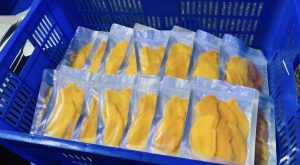
9. Verify Cooling and Post-Drying Hygiene
The product may be exposed again after leaving the dryer.
Cooling, conditioning, sorting and packing must therefore be protected from contamination.
During this stage, inspect:
- Cooling-room cleanliness
- Air and dust control
- Tray and rack sanitation
- Employee movement
- Product exposure time
- Protection from insects
- Handling practices
- Maximum holding time before packing
- Separation from raw-fruit areas
Ask how the factory prevents condensation when warm mango enters a cooler environment.
The factory should also control intermediate product that remains unpacked overnight or waits for laboratory results.
This is a critical part of how to audit a dried mango factory because a well-controlled drying step can be undermined by weak post-drying handling.
10. Compare Moisture Content with Water Activity
Moisture is a major factor in dried mango texture, stability and shelf life, but moisture content and water activity are not interchangeable.
- Moisture content measures the total amount of water in the product.
- Water activity indicates how available that water is to support microbial growth and chemical reactions.
Two products may have similar moisture content but different water activity because of their sugar concentration, formulation and physical structure.
Questions for the audit
- What is the approved moisture range?
- Is there a water activity target?
- At which production stages are measurements taken?
- How many samples are tested per batch?
- How are samples selected?
- Which instruments are used?
- When were the instruments last calibrated?
- Are control samples or verification checks used?
- What happens when results are outside specification?
- Are results included in the Certificate of Analysis?
Do not rely only on a single finished-product result. Review whether the sampling approach can identify differences within a dryer or batch.
Inconsistent moisture may cause some pieces to become hard while others remain too wet and vulnerable to deterioration.
11. Review the HACCP Plan Against Actual Production
A HACCP plan should reflect the product and process being audited.
The Codex Alimentarius General Principles of Food Hygiene provide internationally recognized guidance on food hygiene and the application of HACCP principles.
Ask the factory to provide:
- Product description
- Intended use
- Process flow diagram
- On-site flow confirmation
- Hazard analysis
- Prerequisite programs
- Critical Control Point determination
- Critical limits
- Monitoring procedures
- Corrective actions
- Verification activities
- Validation evidence
- Record-retention requirements
Hazards that may require evaluation
Biological hazards
- Pathogenic microorganisms
- Yeast and mold
- Contaminated process water
- Post-drying contamination
Chemical hazards
- Pesticide residues
- Excessive sulfites
- Cleaning chemical residues
- Undeclared allergens
- Lubricants
- Unapproved additives
Physical hazards
- Metal
- Glass
- Stones
- Hard plastic
- Wood
- Knife fragments
- Equipment parts
- Personal items
Do not only check whether the documents exist. Compare the flow diagram and hazard analysis with what you saw in the factory.
If an actual processing stage is missing from the HACCP plan, the associated hazards may not have been properly evaluated.
12. Evaluate Foreign-Material Controls
Dried mango may be sorted manually and handled through several production stages. This creates opportunities for foreign materials to enter the product.
Review controls for:
- Metal
- Glass
- Hard plastic
- Wood
- Stones
- Mango seeds
- Peel fragments
- Insects
- Personal items
- Equipment parts
Metal-detector verification
If a metal detector is used, check:
- Location in the process
- Product settings
- Detection sensitivity
- Ferrous test standard
- Non-ferrous test standard
- Stainless-steel test standard
- Test frequency
- Rejection mechanism
- Failed-test procedure
- Record completion
- Calibration and maintenance
Ask an employee to demonstrate the verification process.
The system should define what happens to all products processed since the last successful test when the metal detector fails.
13. Review Laboratory Testing and Batch Release
Laboratory testing should reflect the product risks, customer specification and destination-market requirements.
The testing plan may include:
- Moisture
- Water activity
- Total plate count
- Yeast and mold
- Coliforms
- E. coli
- Salmonella
- Sulfur dioxide
- Pesticide residues
- Heavy metals
- Preservatives
- Allergens
- Nutritional values
Assess the testing system
Determine:
- Which tests are performed for every batch
- Which tests follow a periodic risk-based plan
- Which tests are performed in-house
- Which tests are outsourced
- Whether the external laboratory is suitably accredited
- How samples are selected
- Who reviews the results
- What happens when a result fails
Check the Certificate of Analysis
A Certificate of Analysis should be connected to:
- Product name
- Specification
- Production batch
- Production date
- Test date
- Test method
- Actual results
- Required limits
- Release authorization
A generic COA containing standard values rather than actual batch results provides limited evidence.
Batch-release controls
Ask the factory to demonstrate:
- How completed production records are reviewed
- How laboratory results are approved
- Who authorizes product release
- How on-hold stock is identified
- How rejected product is segregated
- How shipment is prevented before approval
This step is central to food supplier due diligence because it shows whether non-compliant products can enter the export supply chain.
14. Conduct a Live Traceability Test
Do not accept a verbal explanation of the traceability system. Test it.
Select one finished-product lot from the warehouse and ask the factory to trace it backward to:
- Raw mango supplier
- Incoming fruit lot
- Receiving date
- Processing batch
- Ingredients and additives
- Packaging materials
- Dryer
- Production records
- Laboratory results
- Release decision
Then trace the lot forward to:
- Packing date
- Finished-goods quantity
- Warehouse location
- Customer
- Invoice
- Container number
- Shipment date
Record the mass balance
Compare:
- Raw material received
- Product produced
- Process loss
- Rejected product
- Rework
- Stock remaining
- Quantity shipped
Significant unexplained differences may indicate weak record control or incomplete traceability.
Review the recall system
Ask for the factory’s most recent mock-recall report.
Check:
- Date
- Selected batch
- Completion time
- Percentage traced
- Quantity reconciliation
- Contact procedure
- Problems identified
- Corrective actions
- Follow-up verification
Knowing how to audit a dried mango factory means testing whether the system works under pressure—not merely confirming that a recall procedure exists.
15. Inspect Packaging and Label Controls
Packaging protects dried mango during warehousing, container transport and distribution.
The correct packaging system depends on:
- Product moisture
- Water activity
- Shelf-life target
- Destination climate
- Distribution conditions
- Retail or bulk format
- Buyer requirements
Primary packaging checklist
Review:
- Food-contact compliance
- Material specification
- Film structure
- Moisture barrier
- Oxygen barrier
- Seal integrity
- Seal strength
- Pouch thickness
- Coding quality
- Net-weight control
- Use of oxygen absorbers or desiccants, when applicable
Bulk packaging checklist
Check:
- Inner liner
- Carton strength
- Sealing method
- Product protection
- Carton dimensions
- Pallet pattern
- Stretch wrapping
- Shipping marks
- Container suitability
Label controls
Confirm control of:
- Product name
- Ingredient list
- Sulfite declaration
- Allergen information
- Nutrition facts
- Net weight
- Country of origin
- Lot number
- Production date
- Best-before or expiry date
- Storage instructions
- Importer details
- Claims and certifications
- Barcode
- Customer artwork
For private-label products, verify how the factory controls:
- Artwork approval
- Revision numbers
- Obsolete labels
- Customer-owned packaging
- Access to digital artwork
- Printing errors
- Line clearance between products
16. Inspect Warehousing and Container Loading
Finished dried mango can deteriorate even after passing production inspection.
Finished-goods warehouse checklist
Check whether:
- The warehouse is clean and dry
- Products are stored off the floor
- Cartons are separated from walls
- Temperature and humidity are monitored
- Lots are clearly identified
- FIFO or FEFO is applied
- On-hold and rejected stock is segregated
- Pest control is effective
- Damaged cartons are controlled
- Strong-smelling chemicals are stored separately
Look for water stains, soft cartons, damaged pallets, condensation or signs of insect activity.
Container-loading checklist
Ask how the factory:
- Inspects containers before loading
- Checks for holes and water leakage
- Detects unusual odors
- Confirms container cleanliness
- Protects cartons during rain
- Controls loading patterns
- Uses container desiccants, where required
- Records the container number
- Records the seal number
- Takes loading photographs
- Maintains dispatch traceability
Container inspection records should be connected to the actual shipment.
17. Review Complaints and Corrective Actions
A factory’s complaint history can reveal risks that may not be visible during a one-day visit.
Request a complaint summary for the previous 12 months or another relevant period.
Common dried mango complaints may involve:
- Mold
- Fermented or unusual odor
- Dark color
- Hard texture
- Excessive stickiness
- Uneven slice sizes
- Foreign materials
- Incorrect weight
- Seal leakage
- Damaged cartons
- Labeling errors
For selected complaints, review:
- Product and batch
- Customer description
- Immediate containment
- Root-cause investigation
- Corrective action
- Preventive action
- Customer response
- Effectiveness verification
- Recurrence
A supplier should not close a complaint simply by replacing the affected products. It should identify why the problem occurred and how recurrence will be prevented.
Vietnam Factory Audit Checklist for Dried Mango Buyers
| Audit area | Evidence to examine | Warning signs |
|---|---|---|
| Manufacturer identity | Registrations, factory address and legal entity | Actual manufacturer is not disclosed |
| Certification | Certificate scope, validity and site address | Certificate covers another site |
| Product specification | Approved technical and sensory requirements | Specifications are incomplete or generic |
| Raw mango sourcing | Approved suppliers and receiving records | Origin or variety cannot be traced |
| Facility hygiene | Site condition and product flow | Standing water, pests or cross-contamination |
| Employee hygiene | Actual working practices | Procedures are not followed |
| Process control | Batch, time and temperature records | Values are undocumented or copied |
| Drying | Parameters and moisture checks | End point is based only on visual judgment |
| Water activity | Results and calibrated equipment | No defined target or test method |
| HACCP | Hazard analysis and monitoring records | Plan does not match actual production |
| Foreign materials | Metal detection and inspection | Failed checks have no containment procedure |
| Laboratory testing | Test reports and COA | Generic results are used for every batch |
| Batch release | Approval and hold procedures | Product can ship before approval |
| Traceability | Raw-to-finished lot records | Incomplete or slow traceability |
| Packaging | Material, seal and label controls | Weak seals or obsolete labels |
| Warehousing | Humidity, stock rotation and pest records | Wet, damaged or unidentified cartons |
| Complaints | Root cause and corrective action | The same issue repeatedly returns |
| Export capability | Shipment and container records | Weak destination-market knowledge |
Critical Red Flags During a Dried Mango Factory Audit
The following findings require immediate investigation:
- The supplier refuses access to production areas
- The production site differs from the certified site
- Manufacturing is outsourced without disclosure
- Raw mango origin cannot be traced
- Employees create records during the audit
- Batch records contain repeated identical values
- Additives are used without controlled recipes
- Sulfite use does not match the label
- Moisture specifications are undefined
- Water activity is never assessed despite relevant product risks
- Certificates of Analysis are not batch-specific
- Failed laboratory results are overwritten or ignored
- There is no effective product-hold system
- Products can be shipped before formal release
- Traceability records are incomplete
- Pest activity is visible
- Exposed product is stored near raw fruit or waste
- Labels are changed without approval
- The factory cannot complete a traceability exercise
One minor housekeeping issue may be corrected quickly. Multiple failures in management systems, records and traceability indicate a more serious supplier risk.
How to Score the Factory
A weighted scorecard helps buyers compare suppliers using consistent criteria.
| Audit category | Suggested weight |
|---|---|
| Food safety and HACCP | 20% |
| Process and drying controls | 15% |
| Facility hygiene and sanitation | 15% |
| Raw material sourcing | 10% |
| Laboratory testing and release | 10% |
| Traceability and recall | 10% |
| Packaging and storage | 10% |
| Export and commercial readiness | 10% |
| Total | 100% |
Use a score from zero to five:
- 5 – Excellent: Fully implemented, documented and consistently verified
- 4 – Good: Effective control with minor improvement opportunities
- 3 – Acceptable: Basic requirements are met, but corrective actions are needed
- 2 – Weak: Significant gaps or inconsistent implementation
- 1 – High risk: Essential controls are largely absent
- 0 – Unacceptable: No evidence of control or evidence of misrepresentation
Do not rely only on the final percentage.
A factory may receive a reasonable overall score but still have one critical issue—such as falsified records, undeclared sulfites or failed traceability—that prevents approval.
What to Do After the Audit
Once the inspection is complete, classify every finding.
Critical finding
An immediate food safety, legal, traceability or integrity risk.
The supplier should not be approved until the issue is corrected and independently verified.
Major finding
A system failure that could affect product safety, compliance or repeated product quality.
Corrective action should be completed before commercial production or within a tightly controlled conditional-approval process.
Minor finding
An isolated issue that does not indicate a complete system failure but still requires correction.
Opportunity for improvement
A recommendation that may improve consistency, efficiency or buyer confidence.
For every finding, record:
- Audit requirement
- Objective evidence
- Risk
- Required corrective action
- Responsible person
- Deadline
- Evidence needed for closure
- Verification method
Photographs, revised procedures and training records may support closure, but major process failures may require a follow-up visit or production trial.
Supplier Approval Decision
After completing your Vietnam factory audit checklist, assign one of the following outcomes.
Approved
The factory demonstrates effective controls and has no unresolved critical or major issues affecting the proposed product.
Conditionally approved
The factory may proceed under defined restrictions while completing corrective actions.
Possible restrictions include:
- Limited trial quantity
- Additional laboratory testing
- Pre-shipment inspection
- Batch-by-batch COA approval
- No formulation changes
- No production-site changes
- Increased audit frequency
Trial order only
The factory shows potential but has not yet demonstrated consistency at commercial scale.
The trial should verify:
- Production consistency
- Final specification
- Packaging performance
- Documentation accuracy
- Shipment preparation
- Product condition on arrival
On hold
Approval is delayed until significant findings are closed.
Rejected
The factory presents unacceptable food safety, integrity, legal, traceability or commercial risks.
The final decision should combine audit results with sample evaluation, laboratory testing, commercial capability and communication performance.
Frequently Asked Questions
Is a certificate enough to approve a dried mango factory?
No. A certificate can support supplier evaluation, but buyers should verify its validity, scope, site address and implementation. An on-site audit provides additional evidence about actual factory conditions and employee practices.
Should the audit take place during dried mango production?
Yes, whenever possible. Auditing during active production allows buyers to observe raw material handling, process controls, hygiene practices, drying records, sorting and packing.
How often should a dried mango supplier be audited?
The frequency should be based on risk. Consider supplier performance, complaints, product risk, certification status, regulatory requirements and significant changes to the facility or process.
Can buyers use a remote audit?
A remote audit can support preliminary screening or corrective-action verification. However, it may not reveal all facility, hygiene, equipment and employee-practice issues visible during an on-site assessment.
Can a third-party audit replace the buyer’s audit?
A credible third-party report can support supplier approval. Buyers should still review the report’s scope, date, auditor competence, product category, findings and corrective-action status.
What records should buyers sample during the audit?
Select records from several recent production dates rather than reviewing only documents chosen by the supplier. Connect raw material, production, testing, release, warehouse and shipment records for the same batches.
What is the most important part of food supplier due diligence?
The strongest supplier evaluation connects documentation with physical evidence. Certificates, procedures, records, employee practices, test results and traceability should all describe the same operating system.
Final Takeaway: How to Audit a Dried Mango Factory Successfully
Understanding how to audit a dried mango factory means looking beyond an attractive sample or a clean production floor.
A reliable supplier should demonstrate:
- Clear manufacturer identity
- Transparent raw mango sourcing
- Defined product specifications
- Controlled washing and preparation
- Consistent drying parameters
- Effective moisture and water activity management
- HACCP-based food safety controls
- Batch-specific laboratory testing
- Formal product release
- Complete traceability
- Suitable packaging
- Controlled storage and container loading
- Effective complaint and corrective-action systems
The best audit question is not simply, “Does the factory have a procedure?”
Ask instead:
- Is the procedure suitable for this product?
- Do employees follow it?
- Are the results recorded?
- Can the factory show evidence?
- What happens when the process fails?
- Is the corrective action effective?
These questions help buyers determine whether a factory can consistently manufacture export-grade dried mango—not just prepare one good sample for approval.
Source Dried Mango from Vietnam with QQIMEX
QQIMEX supports importers, wholesalers, distributors, food-service buyers and private-label brands sourcing dried mango and other processed fruit products from Vietnam.
Buyers can work with QQIMEX to discuss:
- Product specifications
- Sample requirements
- Bulk and retail packaging
- Private-label development
- Quality and testing documents
- Order quantities
- Destination-market requirements
- Export quotations
For more guidance on assessing production capability and export readiness, read our complete guide to selecting a dried mango manufacturer in Vietnam.
Contact QQIMEX to request product specifications, samples and a quotation for your target market.