
Heat-Pump Drying vs Freeze-Drying Mango: Which Technology Makes the Best Dried Mango?
If you are sourcing dried mango for retail, private label, or food service, one question comes up in almost every buyer conversation: heat-pump drying vs freeze-drying mango — which one actually produces the better product? The honest answer is: it depends on what “better” means for your brand. A crunchy, shelf-stable snack calls for a different process than a soft, chewy, naturally sweet mango strip.
In this guide, we break down how both dried mango processing technologies work, how they affect flavor, texture, nutrition, and cost, and how to decide between freeze-dried mango vs soft dried mango for your specific market.
Why the Drying Method Matters So Much
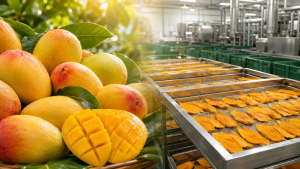
Dried mango is not a single product — it’s a category. Two mango snacks can come from the exact same fruit variety and still taste, feel, and behave completely differently on the shelf, purely because of the technology used to remove moisture. For B2B buyers building a private label line, understanding this difference up front avoids costly mismatches between product expectations and what actually arrives in the container.
That’s why comparing heat-pump drying vs freeze-drying mango isn’t just a technical detail for factory engineers — it directly shapes your product’s positioning, price point, and target customer.
How Heat-Pump Drying Works
Heat-pump drying (sometimes called low-temperature dehydration) circulates dehumidified, temperature-controlled air around mango slices in a closed-loop chamber. Moisture is pulled out gradually at moderate temperatures, typically well below the levels used in old-style hot-air ovens.
Key characteristics of heat-pump dried mango:
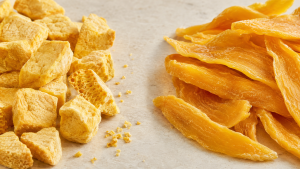
- Texture: Soft, chewy, pliable — the classic “soft dried mango” snacking texture.
- Flavor: Naturally sweet and concentrated, since sugars caramelize slightly during the slow drying cycle.
- Color: Warm golden-amber, close to the fruit’s natural ripened color.
- Shelf life: Long, provided moisture content is tightly controlled — ideal for long-haul export shipping.
- Cost efficiency: Lower energy consumption and equipment cost than freeze-drying, which keeps factory-gate pricing competitive for bulk and OEM orders.
This is the technology behind most of the soft, chewy dried mango found in supermarkets and snack aisles worldwide, and it remains the workhorse process for large-scale, container-level (FCL) export supply.
How Freeze-Drying Works
Freeze-drying (lyophilization) takes an entirely different approach. Mango is first frozen solid, then placed in a vacuum chamber where the ice is converted directly into vapor through sublimation — skipping the liquid phase entirely. Because the process never exposes the fruit to significant heat, the mango’s cellular structure stays largely intact.
Key characteristics of freeze-dried mango:
- Texture: Light, crispy, almost airy — it shatters rather than chews.
- Flavor: More concentrated and “true to fruit,” since almost no heat-driven flavor change occurs.
- Nutrient retention: Generally higher retention of heat-sensitive vitamins compared to heat-based drying methods.
- Shelf life: Extremely long and highly stable, provided packaging keeps out moisture and oxygen.
- Cost: Significantly higher processing cost due to energy-intensive vacuum and freezing equipment, which is reflected in a higher per-kilogram price.
Freeze-Dried Mango vs Soft Dried Mango: Side-by-Side Comparison
| Factor | Heat-Pump Dried (Soft) Mango | Freeze-Dried Mango |
|---|---|---|
| Texture | Chewy, moist, flexible | Crispy, light, crunchy |
| Typical use case | Everyday snacking, trail mixes, bakery inclusions | Premium snacks, healthy-food positioning, baby food, cereal toppings |
| Moisture content | Low-moderate | Near-zero |
| Nutrient retention | Good | Very high |
| Production cost | Lower | Higher |
| Retail price point | Mass-market to mid-premium | Premium |
| Shelf stability | Long (with proper packaging) | Very long (with proper packaging) |
Neither technology is universally “better” — the right choice depends entirely on the product experience your brand wants to deliver, and the price point your target market will support.
Which Technology Should Private Label Buyers Choose?
For most international importers and private-label brands, the decision comes down to three questions:
- What texture does your target customer expect? Mass-market snack buyers usually expect the familiar chewy, soft dried mango experience. Health-food and premium retail channels increasingly favor the crispy, “clean label” appeal of freeze-dried fruit.
- What is your target retail price? Freeze-dried mango commands a premium price but comes with meaningfully higher production costs. Heat-pump dried mango offers better margins at accessible price points.
- How will the product be used? Soft dried mango works well eaten straight from the pack. Freeze-dried mango is often preferred for dry applications — granola, trail mix, cereal, or rehydration-based recipes — where its crisp, lightweight structure adds value.

Why the Right Manufacturing Partner Matters
Whichever process you choose, execution quality depends heavily on the factory behind it. Inconsistent moisture control, poor raw material sourcing, or outdated equipment can undermine either drying method — resulting in inconsistent batches, shorter shelf life, or compliance issues at customs.
A manufacturer equipped with both heat-pump drying and freeze-drying systems gives buyers flexibility: the ability to test formats, run pilot batches, and scale into whichever product line performs best in-market — without needing to switch suppliers. Production lines built around FDA registration, HACCP, ISO 22000, and HALAL/KOSHER certification also ensure the finished product clears the compliance bar for the USA, EU, Australia, Korea, Japan, and Middle East markets.

Final Thoughts
There is no single winner in the heat-pump drying vs freeze-drying mango debate — only the right fit for your brand, your customer, and your price point. Soft, heat-pump dried mango remains the reliable, cost-effective choice for everyday snacking formats and bulk export volume. Freeze-dried mango serves the growing premium and health-conscious segment willing to pay more for a crisp, nutrient-dense format.
For a deeper look at how to evaluate and select a dried mango manufacturing partner — covering certifications, MOQs, private-label services, and export logistics — see our complete guide: Dried Mango Manufacturer Vietnam: The Complete Guide for Global Buyers & Private Label Brands.
If you’re ready to source premium Vietnamese dried mango in either soft-dried or freeze-dried format, visit Q&Q IMPORT EXPORT CO.,LTD to request a quote, product samples, or an OEM/private-label proposal. You can also follow product updates and factory news on our Facebook page.