
Natural Dried Mango vs Sun-Dried: What B2B Buyers Need to Know Before Sourcing
When comparing natural dried mango vs sun-dried mango, B2B buyers should look beyond attractive samples and low unit prices. For importers, wholesalers, distributors, and private-label brands, the real question is whether a supplier can deliver the same food safety, moisture level, color, texture, and flavor across every commercial batch.
Traditional sun drying may appear economical because it uses direct sunlight and requires relatively simple equipment. However, when mango slices are exposed to changing weather, dust, insects, and uncontrolled humidity, product quality can vary considerably. These variations become especially risky when a buyer is purchasing a full container load for international distribution.
Naturally controlled drying provides a more reliable alternative. Technologies such as heat-pump drying and freeze-drying allow manufacturers to manage temperature, airflow, humidity, and processing time inside a controlled environment. The objective is not to make mango less natural. It is to preserve its natural characteristics under safer and more repeatable production conditions.
For global buyers, this difference affects much more than appearance. It can influence laboratory results, shelf life, customer complaints, customs clearance, inventory losses, and long-term brand reputation.
As a Vietnamese dried-fruit manufacturer and exporter, QQIMEX supplies soft-dried fruit for international markets and supports bulk and private-label sourcing requirements. This guide explains the main differences buyers should evaluate before selecting their next dried mango supplier
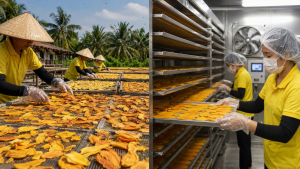
Understanding the Fundamentals: Sun-Dried vs. Naturally Controlled Dried Mango
Both sun drying and controlled drying remove water from fresh mangoes to slow deterioration and extend product usability. The critical difference lies in how the drying environment is managed.
Open-air sun drying depends primarily on solar heat and natural airflow. Its performance changes according to sunlight intensity, ambient temperature, wind, and relative humidity. Drying may take longer during cloudy or humid weather, and different trays—or even different pieces on the same tray—may not dry at the same rate.
Naturally controlled dried mango is processed inside equipment where the manufacturer can define and monitor operating conditions. Depending on the required product format, the factory may use low-temperature dehydration, heat-pump drying, or freeze-drying.
“Natural” and “sun-dried” should therefore not be treated as interchangeable terms. Mango can retain a natural flavor and ingredient profile while being produced with modern controlled drying technology. For procurement teams, the more useful questions are:
- How is the mango protected during processing?
- Are temperature, humidity, and drying time recorded?
- Is finished-product moisture or water activity measured?
- Can the supplier reproduce the same specification across multiple batches?
- Are microbiological and chemical test reports available?
This distinction is essential when comparing suppliers whose marketing language may sound similar but whose production controls are very different.
What Is Sun-Dried Mango?
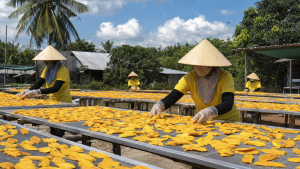
Sun-dried mango is made by placing peeled and sliced mangoes under direct sunlight, usually on racks, trays, mats, or drying yards. The fruit remains exposed until enough moisture has evaporated to produce a shelf-stable or semi-dried product.
The method is inexpensive and can work at small scale in dry, predictable climates. However, it gives processors limited control over drying conditions. Rain, overnight humidity, fluctuating temperature, airborne dust, birds, insects, and other environmental factors can affect the finished product.
The FAO notes that traditional sun drying offers limited control over processing conditions and can expose products to dirt, animals, insects, and mold. Properly designed enclosed solar dryers can reduce some of these risks, but open-air drying remains difficult to standardize for high-volume export orders.
What Is Naturally Controlled Dried Mango?
Naturally controlled dried mango is produced from fresh mangoes using enclosed drying systems with managed temperature, humidity, airflow, and processing time.
Heat-pump or low-temperature drying is commonly used for soft-dried mango because it removes moisture gradually while helping retain the fruit’s aroma, golden color, and chewy texture. Freeze-drying uses freezing and vacuum-based sublimation to produce a light, crisp product with a different structure and premium positioning.
Both technologies give manufacturers greater control over the process. Recipes can be adjusted according to mango variety, ripeness, slice thickness, target moisture, texture, and customer specification.
Sun-Dried Mango Risks: Critical Factors for Bulk Importers
The most important sun-dried mango risks are not always visible during sample approval. A small sample may look acceptable, while a commercial batch can contain significant variation caused by uneven drying or handling conditions.
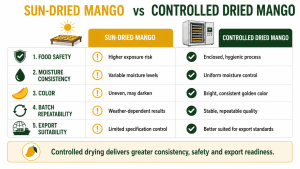
For B2B buyers, the financial exposure increases with volume. A problem affecting several kilograms is manageable; the same problem throughout a container can lead to relabelling, reworking, disposal, customer claims, or rejection.
Importers should therefore evaluate the production process—not only the supplier’s best samples.
Microbiological Contamination and Mold Hazards
Mango slices placed in an open environment may be exposed to dust, insects, birds, animals, contaminated surfaces, and airborne microorganisms. When drying is too slow, microorganisms can remain active while the fruit retains sufficient available moisture for growth.
Mold risk is particularly important because visible mold may represent only part of the problem. A shipment can also develop off-odors, fermentation, surface stickiness, or microbial counts that do not meet the buyer’s specification.
Codex guidance treats sun-drying yards as food-processing areas and requires protection against rodents, insects, birds, debris, and dust. This illustrates why commercial sun drying needs far more control than simply placing fruit outdoors.
Buyers should request recent batch-specific laboratory results, including the relevant microbiological parameters for their target market and product category.
Color Browning and Unstable Moisture Content
Mango’s yellow-orange appearance is a major retail selling point. Prolonged exposure to oxygen, sunlight, and uncontrolled heat can accelerate browning and reduce visual consistency. Some pieces may become dark and overly dry, while others remain pale, sticky, or insufficiently dehydrated.
Uneven moisture creates an additional logistics risk. Moist pieces may release water into the packaging or transfer moisture to drier pieces. During a long sea journey, temperature changes can worsen condensation and moisture migration, especially if packaging barriers and container conditions are inadequate.
Moisture percentage alone does not provide a complete safety assessment. Water activity indicates how much water is available to support microbial growth. The FDA explains that controlling water activity is a key part of limiting the growth of bacteria, yeast, and mold.
A professional specification should therefore define the target moisture range, water-activity limit where appropriate, test method, packaging format, and storage conditions.
Regulatory Non-Compliance in Strict Export Markets
Dried mango imported into the United States, the European Union, Japan, South Korea, and other regulated markets must comply with applicable food safety, contaminant, hygiene, packaging, and labelling requirements.
The exact requirements vary by country and intended use. Buyers may need documentation covering microbiological results, pesticide residues, heavy metals, additives, allergens, traceability, nutritional information, and packaging compliance.
In the EU, microbiological testing is only one component of a broader food-safety management system; testing alone cannot guarantee that a product is safe. Preventive hygiene controls and documented production systems remain essential.
If a shipment fails the agreed specification or local requirements, potential consequences include additional inspection, delayed release, rejected delivery, product withdrawal, or return costs. Importers should approve documentation before production instead of waiting until the container reaches the destination port.
Controlled Drying Technology Mango: The Modern B2B Solution
For large-volume sourcing, controlled drying technology mango production offers a more predictable route to food safety, consistency, and scalable quality.
Enclosed processing does not automatically guarantee a perfect product. The factory still needs suitable raw materials, sanitation programs, calibrated equipment, documented procedures, trained workers, traceability, laboratory verification, and appropriate packaging.
However, controlled technology gives manufacturers the tools to define a repeatable process and investigate deviations when they occur.
Heat-Pump and Freeze-Drying Preservation Systems
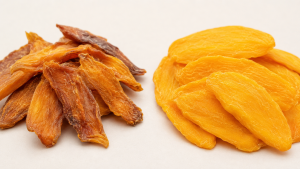
Heat-pump drying circulates conditioned air through an enclosed chamber. The system removes moisture while maintaining a relatively low and stable processing temperature. This makes it suitable for soft-dried mango intended to remain flexible, chewy, and naturally aromatic.
The main commercial benefits can include:
- More stable drying conditions
- Reduced dependence on outdoor weather
- Better control over color and texture
- Protection from environmental contamination
- Greater consistency between production batches
- Easier scale-up for recurring wholesale orders
Freeze-drying serves a different product segment. Mango is frozen before water is removed through sublimation under vacuum. The result is typically crisp, porous, lightweight, and suitable for premium snacks, cereals, bakery inclusions, or powdered applications.
Heat-pump dried mango and freeze-dried mango should not be compared only by price. They provide different sensory experiences, packaging requirements, freight densities, and retail propositions.
Precision Moisture Control for Extended Shelf Life
Many soft-dried mango specifications target a controlled moisture range—sometimes approximately 15–20%—but there is no universal figure suitable for every recipe. Sugar content, additives, slice thickness, packaging, water activity, and target texture all influence product stability.
A shelf-life claim of approximately 9–12 months may be achievable for properly processed and packaged products stored under specified conditions. It should nevertheless be supported by the manufacturer’s product specification and shelf-life validation rather than assumed from moisture percentage alone.
B2B buyers should confirm:
- Finished-product moisture specification
- Water-activity limit and test method
- Packaging material and oxygen/moisture barrier
- Recommended storage temperature and humidity
- Shelf life from production date
- Whether the product contains added sugar or preservatives
- Testing frequency and Certificate of Analysis availability
Precision control helps reduce the chance of receiving mango that is too wet for stable shipping or too dry for the intended soft, chewy positioning.
Consistency in Taste, Texture, and Visual Appeal
Modern drying systems allow factories to standardize operating parameters for each product. This improves the probability that approved samples match future commercial shipments.
Consistency matters to every participant in the value chain. Retailers want uniform packs on the shelf. Consumers expect the same flavor and texture each time. Distributors need fewer complaints. Private-label owners must protect their brand promise across multiple production runs.
A reliable supplier should establish measurable acceptance criteria for color, cut size, thickness, broken pieces, foreign matter, flavor, texture, moisture, water activity, and microbiological performance.
No agricultural product can be literally identical in every piece. A credible manufacturer controls natural variation within an agreed tolerance instead of promising unrealistic “100% identical” output.
Side-by-Side Comparison: Sun-Dried vs. Controlled Dried Mango
| B2B criterion | Traditional open-air sun-dried mango | Controlled dried mango |
|---|---|---|
| Drying environment | Exposed or partially exposed to outdoor conditions | Enclosed and monitored |
| Weather dependence | High | Low |
| Temperature and humidity control | Limited | Defined and adjustable |
| Contamination exposure | Higher without protected facilities | Lower with proper hygiene controls |
| Moisture consistency | Can vary by weather, tray, and slice | More consistent within an approved tolerance |
| Color | Greater risk of darkening or uneven appearance | Better potential for stable golden color |
| Texture | May range from overly dry to sticky | Adjustable for soft, chewy, or crisp formats |
| Batch repeatability | Difficult at commercial scale | More suitable for recurring B2B orders |
| Shelf-life management | Less predictable without testing | Supported by controlled processing and packaging |
| Traceability | Depends heavily on producer practices | Easier to integrate into documented factory systems |
| Market acceptance | May suit local or artisanal channels | Better suited to formal export and private-label programs |
| Cost structure | Lower processing investment | Higher technology and quality-control investment |
| Best application | Small-scale or rustic positioning with verified controls | Wholesale, export, retail, ingredients, and OEM programs |
The lower initial price of sun-dried mango does not necessarily represent the lowest total sourcing cost. Buyers should also account for sorting losses, rejected pieces, inconsistent net yield, inspection delays, claims, repacking, and damage to customer relationships.
Why QQIMEX Is a Vietnamese Partner for Export-Grade Dried Mango
QQIMEX offers Vietnamese soft-dried fruit products for buyers seeking commercial quantities, export support, and private-label development.
According to the company’s published information, its current portfolio includes soft-dried mango, dragon fruit, passion fruit, pineapple, and papaya. QQIMEX states that it has supplied markets including the United States, China, Europe, Taiwan, and South Korea.
For procurement teams, the next step is to translate this manufacturing capability into a buyer-specific technical agreement covering ingredients, quality limits, testing, packaging, volume, lead time, and destination-market compliance.
Strategic Raw Material Sourcing and Modern Factory Capacity
Vietnam’s tropical climate supports commercial mango cultivation and gives manufacturers access to suitable fruit during different harvest periods. Effective sourcing still requires control over variety, ripeness, size, defects, pesticide management, transportation, and incoming inspection.
QQIMEX reports approximately 100 hectares of agricultural land and manufacturing capacity of up to 3,000 tons per year across its dried-fruit operations. Its factory is located in An Giang, while its head office is in Ho Chi Minh City.
This combination of raw-material access and factory processing can support scheduled wholesale programs. Importers planning monthly full-container-load orders should confirm available capacity for the required SKU, harvest calendar, minimum order quantity, production lead time, and contingency arrangements directly with the supplier.
Quality Systems and Export Documentation
The QQIMEX website currently identifies ISO 22000:2018, VietGAP-certified farms, Vietnamese food-safety compliance, and GACC export authorization among its published credentials. QQIMEX company information
Certification requirements should always be verified for the specific factory, product, and shipment. Buyers requiring FDA-related facility documentation, HACCP plans, HALAL, KOSHER, organic certification, or market-specific registrations should request valid copies and confirm their scope and expiry dates before issuing a purchase order.
A robust supplier-approval package may include:
- Business and factory registration
- Current certificates and audit reports
- Product specification sheet
- Ingredient and additive declaration
- Allergen statement
- Nutrition information
- Traceability procedure
- Certificate of Analysis
- Pesticide-residue and heavy-metal reports
- Packaging compliance documents
- Country-of-origin and export documentation
This verification protects both parties and prevents assumptions based only on logos displayed in marketing materials.
Flexible Wholesale and OEM/Private-Label Services
QQIMEX can discuss bulk and private-label requirements with international buyers, including product format, sweetness level, slice specification, packaging size, artwork, carton configuration, and shipping volume.
Before mass production, buyers should approve a physical sample, final specification, packaging proof, testing plan, commercial terms, and pre-shipment inspection procedure. OEM timelines should also include artwork approval and packaging-material production—not only mango processing time.
Frequently Asked Questions
Is Sun-Dried Mango Suitable for Commercial B2B Export?
Sun-dried mango can be exported if it is produced in a hygienically controlled facility, protected during drying, validated through testing, and compliant with the destination market’s requirements.
However, traditional open-air drying presents higher consistency and contamination risks. For recurring container orders, buyers generally benefit from enclosed, controlled drying because it provides better process repeatability and documentation.
What Is the Shelf Life of Controlled Naturally Dried Mango for Ocean Shipping?
Controlled soft-dried mango may have a shelf life of around 9–12 months when it is properly processed, sealed in suitable high-barrier packaging, and stored under the conditions stated by the manufacturer.
The final shelf life depends on formulation, moisture, water activity, packaging, oxygen exposure, temperature, and validation data. Buyers should request the product specification and shelf-life evidence for the exact SKU being ordered.
Does Controlled Drying Mean the Mango Is No Longer Natural?
No. Controlled drying describes the processing environment, not necessarily the ingredient composition. Mango can be dried under controlled temperature and humidity while retaining its natural flavor and without relying on strong preservatives.
Buyers should check the ingredient declaration to determine whether the product contains added sugar, sulfites, colors, flavors, or other additives.
How Can I Order OEM or Bulk Dried Mango Samples from QQIMEX?
Send QQIMEX your target market, required product type, annual volume, expected order size, ingredient preferences, packaging format, certifications, and desired delivery schedule.
You can request samples and a quotation through the QQIMEX website, email Kyle@qqimex.com, or contact WhatsApp/Viber at +84 903 978 867. For an accurate quotation, specify whether you need bulk cartons, retail-ready packaging, or a complete OEM/private-label service.
Conclusion: Choose Process Control, Not Just a Lower Price
In the natural dried mango vs sun-dried comparison, the key sourcing difference is process control. Traditional sun drying may offer a lower initial production cost, but inconsistent moisture, environmental exposure, color variation, and limited batch repeatability can create substantial risks for bulk importers.
Controlled heat-pump and freeze-drying systems provide a stronger foundation for export-grade production. They enable better management of moisture, water activity, texture, appearance, hygiene, and batch consistency—factors that directly affect shelf life and market acceptance.
For distributors, wholesalers, retailers, and private-label brands, supplier selection should be based on verified specifications, factory systems, test results, packaging performance, and commercial reliability.
Looking for a Vietnamese partner for soft-dried mango, bulk supply, or OEM production?.Contact QQIMEX to request samples, technical specifications, current certification documents, and a quotation for your target market. Buyers can also explore QQIMEX’s complete guide to choosing a dried mango manufacturer in Vietnam before submitting a sourcing inquiry.